
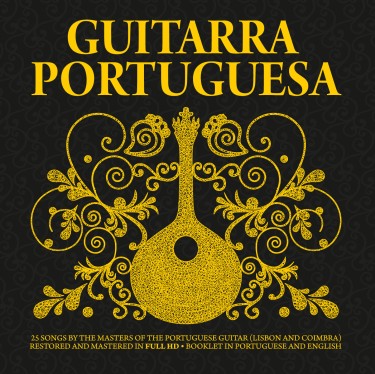
Guitarra Portuguesa
Price:
€9,00
Artist: Various
Album: GUITARRA PORTUGUESA
Format: CD (Booklet Portuguese/English)
Genre: World Music/Portuguese Guitar
Total running time: 01:15:18
Cat.#: SM013-CD
Ean: 5606562620288
Release date: 05.11.12
On the album Guitarra Portuguesa one can listen to 25 guitar and viola interpretations by some of the great masters who are part of the culture and imagery of Portugal.
This work exemplifies the vast repertoire that can be interpreted by these stringed instruments such as
variations, rhapsodies, ballades, fados and other popular themes.
A bit of history: PORTUGUESE GUITARAccording to studies conducted by some scholars and instrumentalists such as Pedro Caldeira Cabral and António Portugal and others, the origin of the Portuguese guitar dates back to the late eighteenth century, a fusion of the European cittern or zither - chordophone common across Western Europe and the English guitar that arrived in Portugal via the city of Oporto through the commercial trades between the Portuguese and the English.
In turn, Carlos Paredes in his studies states that the Portuguese guitar has origins in citole, an instrument invented earlier in the Middle Ages before the cittern, stating "the musical instrument we call today the Portuguese guitar... was invented in England in the second half of the eighteenth century."
As this matter does not meet common consensus, there is another current theory that suggests an Arab origin from the Arab Moorish guitar in the Middle Ages.
The fact is that the Portuguese guitar is a traditional Portuguese stringed instrument identifiable anywhere in the world for its unmistakable sound. Since the beginning it is a great instrument for concerts with its own repertoire, despite being the main instrument accompanying fado, to which it was definitively added in the second half of the nineteenth century. It is a handmade instrument built with wood and fine materials, it´s main features are: the 12 steel strings arranged in 6 pairs or orders, the mobile bridge made of bone, the round resonance-box, the little arm with ornamented volute and fan-shaped machine heads, the inlaid nacre or the ornaments on the wood itself.
It´s sound is unique and difficult to describe with a bright tone with great depth of treble, suitable for a soloist instrument. Often within the fado circle one uses verbs more related to emotions to describe the sound like "crying", "moan", "trill", "sing", "rhyme", "vibrate" or "melt".
Regarding construction, the two most used variants are the Lisbon and Coimbra guitar. Visually it is easy to distinguish the different volutes; Lisbon’s guitar has the form of a snail while Coimbra has a teardrop shape. The body and neck dimensions of the Coimbra guitar are slightly larger, giving it a fuller sound with more volume and less treble. The tunings are also different, the tuning of the Lisbon guitar is (B, A, E, B, A, D) from the high note to the lower, while its counterpart of Coimbra tunes one note down (A, G, D, A, G, C).
All these singularities make this instrument an icon of Portuguese culture.
SevenMuses © 2018
Carlos Paredes – Serenata
Conjunto de Guitarra de Raúl Nery – Lisboa ao entardecer
Domingos Camarinha – Nocturno
Jorge Fontes – Melodia triste
Casimiro Ramos – Variações em Mi menor
José Nunes – Variações em Lá menor Nº2
Francisco Carvalhinho – Fado canção
Carlos Paredes – Danças portuguesas Nº1
Eduardo Melo e António Portugal - Morena
Jaime Santos – Fado velho
Francisco Carvalhinho – Recordações - Rapsódia
Artur Paredes e Carlos Paredes – Passatempo
Casimiro Ferreira, António Portugal e Eduardo Melo – Variações em Ré menor
Jorge Fontes – Lamentos da minha guitarra
Quarteto de Guitarras de Martinho D’Assunção – Tudo isto é fado
Jaime Santos – Marcha fadista
Carlos Paredes – Variações em Si menor
José Nunes – Variações no Fado Lopes
Domingos Camarinha – Variações sobre fado corrido
Guitarristas Privativos da Estoril – Variações em Ré
Quarteto de Guitarras de Martinho D’Assunção – Fado Faia
Conjunto de Guitarra de Raúl Nery – Motivos regionais
António Portugal e Jorge Godinho – Variações em Lá maior
Artur Paredes e Carlos Paredes – Rapsódia Nº2
Carlos Paredes – Variações em Lá menor
